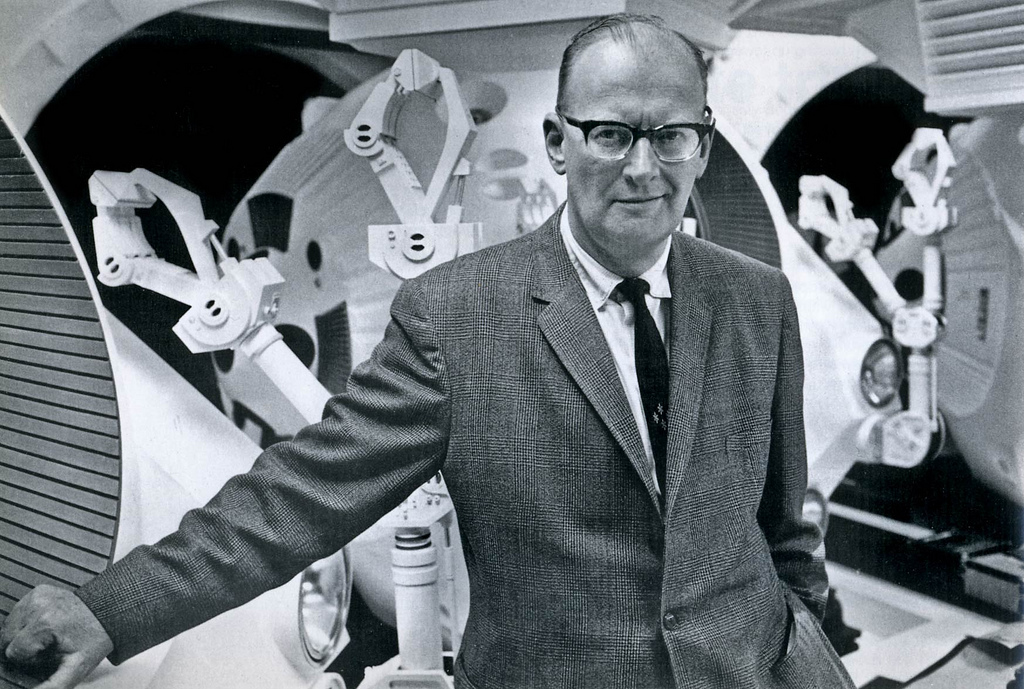
Arthur C. Clarke was a British science-fiction writer and futurist, best known to many people as co-writer of 2001: A Space Odyssey. He also spent years thinking in public about communications, computers and life in space. This page is a short, sourced look at two of those moments: a 1945 magazine paper on communications satellites, and a 1964 BBC appearance in which he tried to describe the world of the year 2000.
The 1945 satellite paper
In October 1945, Clarke published “Extra-Terrestrial Relays: Can Rocket Stations Give World-wide Radio Coverage?” in the British magazine Wireless World. In that paper he set out how a station in a 24-hour equatorial orbit would stay over the same point on Earth, and how three such relays, spaced around the equator, could provide worldwide radio coverage.[1][2]
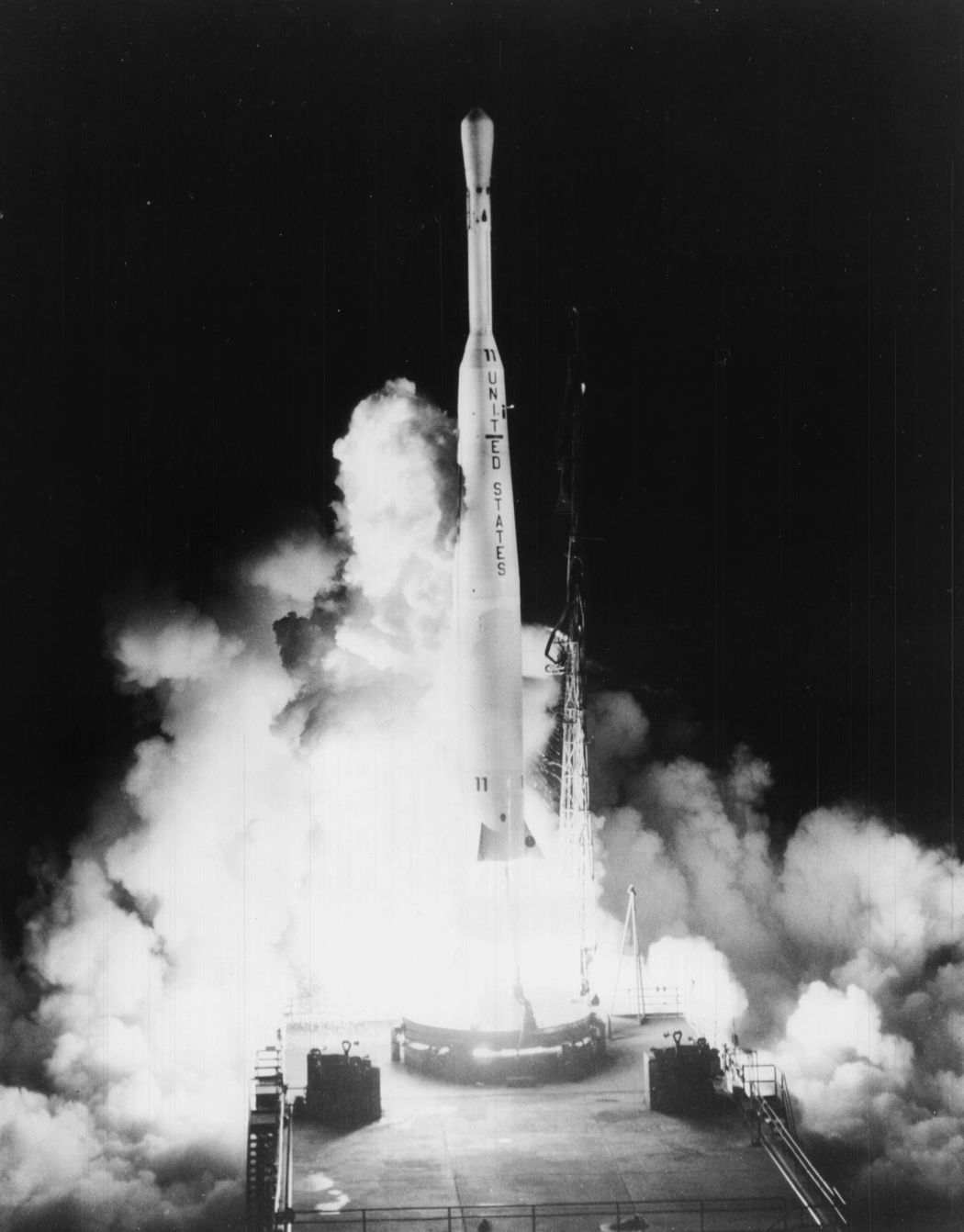
The International Telecommunication Union later described the article as establishing the feasibility of satellites as relay stations for Earth-based communications.[1] That idea was already moving from paper into hardware in the early 1960s: NASA’s Telstar 1, launched on 10 July 1962, opened an era of transatlantic satellite television,[3] and NASA’s Syncom spacecraft followed as the first geosynchronous communications satellites.[4]
Thor/Delta launches Telstar 1 from Cape Canaveral, 10 July 1962. Photograph: NASA, public domain. Source: NASA’s Telstar history page.
The 1964 BBC Horizon talk
On 21 September 1964, Clarke appeared in the BBC Two science series Horizon, in an episode called “The Knowledge Explosion.” The BBC still has an archive clip from that programme: 1964: Arthur C Clarke predicts the future.[5]
He began by saying how hard the future is to predict, then made a set of forecasts. Some of them now look familiar. He argued that the transistor and, above all, the communications satellite would make it possible to be in instant contact with people anywhere on Earth, even without knowing their physical location. He suggested that, perhaps only fifty years on, a person could conduct business from Tahiti or Bali just as well as from London, and he said he was perfectly serious about the idea of a surgeon in Edinburgh one day operating on a patient in New Zealand. In the same talk he said people would no longer commute: they would communicate, and travel for pleasure rather than for work.[6][7]
He also looked further ahead, to machines — “the remote descendants of today’s computers” — that would, he said, “completely outthink their makers.” The BBC’s own summary of the clip mentions “super-intelligent computers.” Not every forecast landed. The same BBC page notes that he questioned whether cities would still exist in the year 2000, and that he also talked about suspended animation.[8][5]
[3] NASA. “Telstar Opened Era of Global Satellite Television.” nasa.gov.
[4] NASA / Wikimedia Commons. “Syncom, the First Geosynchronous Satellite” (GPN-2002-000123). NASA public-domain image page.
[5] BBC. “1964: Arthur C Clarke predicts the future.” Archive clip from Horizon, originally broadcast 21 September 1964. bbc.com/videos/crezjvd55gro.
[6] Fortune (29 May 2024). “Arthur C. Clarke, ‘2001: A Space Odyssey’ author, correctly predicted modern living 60 years ago.” fortune.com.
[7] Popova, M. (30 September 2011). “Arthur C. Clarke Predicts the Future in 1964.” The Marginalian. themarginalian.org.
[8] Quote Investigator (29 May 2026). Research on Clarke’s 1964 wording, including “completely outthink their makers,” citing the BBC Archive upload of Horizon: The Knowledge Explosion. quoteinvestigator.com.